May Statistics
I’ve been DXing here for a long, long time. Here are a few statistics to chew on.
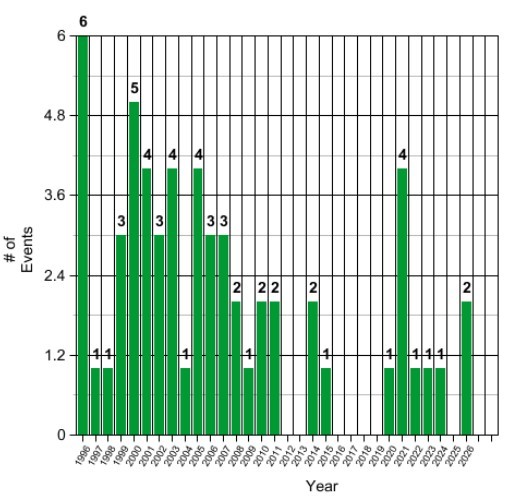
For those who wonder whether May is the beginning of skip season, I present this graph to you. This graph is accurate for Southern New England. I’ve been DXing the FM bands here since the middle 70s (actually longer than that) but only decided to document May skip events since 1996. A graph of the past 30 years should give a good representation of what to expect.
So yes, skip does happen in May but not as much as occurred in the early 2000s. 1996 was a great year for May Es, as well as some of the years previous to it. Not much skip has been observed since 2011 with the exception of 2021 when there were four skip events.
New Skip Stations over the Years
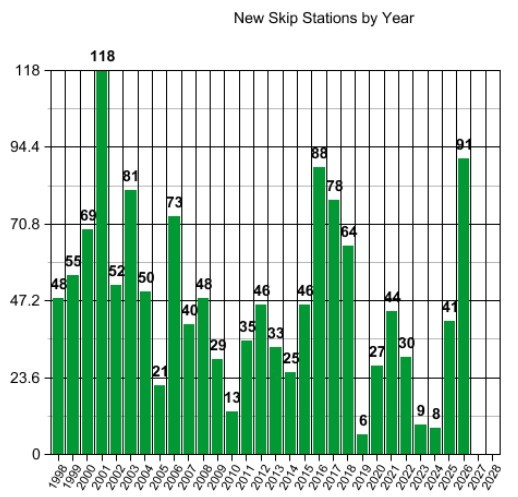
I think everyone would agree that generally speaking, the more stations you have logged, the harder it is going to be to log more of them. Sounds reasonable? And the more you log, the fewer of them are going to be new. So what’s going on with the graph on the right?
I was doing well with logging new stations until 2009. There was a drop in logs that lasted until 2017, a rebound of three years and then the floor dropped out until 2025 with a massive rebound in 2026.
The drop in 2009 happened because of HD radio. Suddenly it seems, I found myself with around 17 local stations broadcasting in HD. Multiply 17 by 2 and you come up with 34 FM channels covered with IBOC hiss. This was not easy to overcome. I tried different radios and started using antenna phasing. It was no fix, but it helped.
Then we move on to 2018. This drop was due to the lack of skip. Mother Nature was just not co-operating. 2025 and 2026 were once again on the upswing. This time I had my trusty TEF radio with almost instant RDS decodes. In 2026 I did not use an SDR for DXing skip. I didn’t use antenna phasing either. I just used by TEF Webserver. I watched the software, I noted the PI codes and logged them into the WTFDA WLogger as I saw them. It’s a quick and dirty method and it worked.